The Vedas Manifested on Earth as the Ramayana
In Sanatan Dharma, the Vedas are regarded as the highest source of spiritual authority. They form the foundation of Dharma, knowledge, worship, and liberation. On the other hand, the Shrimad Valmiki Ramayana is revered as the sacred history of Bhagwan Shri Ram. Most people study these as two separate subjects—the Vedas on one side and the Ramayana on the other.
However, Maharshi Valmiki himself reveals a remarkable truth that connects them.
One of the most celebrated verses of the Shrimad Valmiki Ramayana declares:
Vedavedye Pare Pumsi Jate Dasharathatmaje
Vedah Prachetasad Asit Sakshad Ramayanatmana
Meaning: When the Supreme Being, who is known through the Vedas, descended to earth as Shri Ram, the son of King Dasharatha, the Vedas themselves manifested through Maharshi Valmiki (Prachetas) in the form of the Ramayana.
This verse presents the central siddhānta of this article. According to Maharshi Valmiki, the Ramayana is not merely a sacred narrative about Bhagwan Shri Ram; it is the Vedas themselves expressed in literary form.
This traditional understanding is further supported by another well-known scriptural statement:
Itihasa-Puranabhyam Vedam Samupabrimhayet
It teaches that the deeper meaning of the Vedas is explained through the Itihasas (sacred histories) and the Puranas.
Traditional Acharyas point out that the word Itihasa appears before Purana in this verse. They explain that history occupies a unique place because it records events as they occurred. Maharshi Valmiki was a contemporary of Bhagwan Shri Ram. Having directly witnessed His divine life and deeds, he composed the Shrimad Valmiki Ramayana. For this reason, the Ramayana occupies a unique position in the Sanatan tradition as an authentic Itihasa.
The 24 Syllables of the Gayatri Mantra and the Ramayana
In the Sanatan tradition, Om (ॐ) is regarded as the essence of all the Vedas. The Gayatri Mantra is the essence of the Vedas, and for this reason it is revered as Vedamata—the Mother of the Vedas.
Traditional Acharyas explain that the principal portion of the Gayatri Mantra begins with “Tat Savitur Varenyam…” and concludes with “…Prachodayat.” In other words, the mantra begins with the syllable ‘Ta‘ and ends with ‘Ta‘.
Maharshi Valmiki followed the same sacred pattern while composing the Shrimad Valmiki Ramayana. The very first shloka of the Ramayana begins with “Ta”:
Tapah Svadhyaya Niratam Tapasvi Vagvidam Varam
Naradam Paripapraccha Valmikir Munipungavam
According to the traditional understanding, the final shloka of the Ramayana also concludes with the syllable “…tat (भयात्).”
Idam Amritanibham Purakritam Vai Bhagavata Valmikina Cha Kavyam
Yah Shrunuyat Sa Cha Papakarmabhyah Pramuchyeta Hi Gacchet Param Gatim Naranam Bhayat
Traditional Acharyas further explain that Maharshi Valmiki composed the 24,000 shlokas of the Ramayana in accordance with the 24 syllables of the Gayatri Mantra. After every one thousand shlokas, the next syllable of the Gayatri Mantra appears in sequence. These twenty-four selected verses are collectively known as the Gayatri Ramayana.
The Gayatri Ramayana
The complete original text of these twenty-four divine verses, manifested from the twenty-four sacred syllables of Veda Mata Gayatri, along with their respective Kandas and exact shloka numbers, can be read on our dedicated page: Srimad Valmiki Ramayan: The 24 Divine Verses of the Gayatri Ramayana
‘Om Tat Sat’, the Four Vedas and the Ramayana
The structure established by Maharshi Valmiki is not limited to the twenty-four syllables of the Gayatri Mantra. In this context, revered Acharyas also draw attention to a well-known verse from the Bhagavad Gita:
Om Tat Sad Iti Nirdesho Brahmanas Trividhah Smritah
This verse declares that Om, Tat, and Sat are the three sacred names of the Supreme Brahman.
The principal portion of the Gayatri Mantra begins with “Tat Savitur Varenyam…” and concludes with “…Prachodayat.” Traditional Acharyas explain that this sacred arrangement reflects the profound relationship between the Gayatri Mantra and the Shrimad Valmiki Ramayana, revealing yet another dimension of its Vedic foundation.
One Bhagwan Appeared in Four Forms and the Four Vedas Manifested as the Ramayana
In his celebrated commentary Ramayana Bhushana, Sri Govindaraja Swami explains another profound principle of the Ramayana.
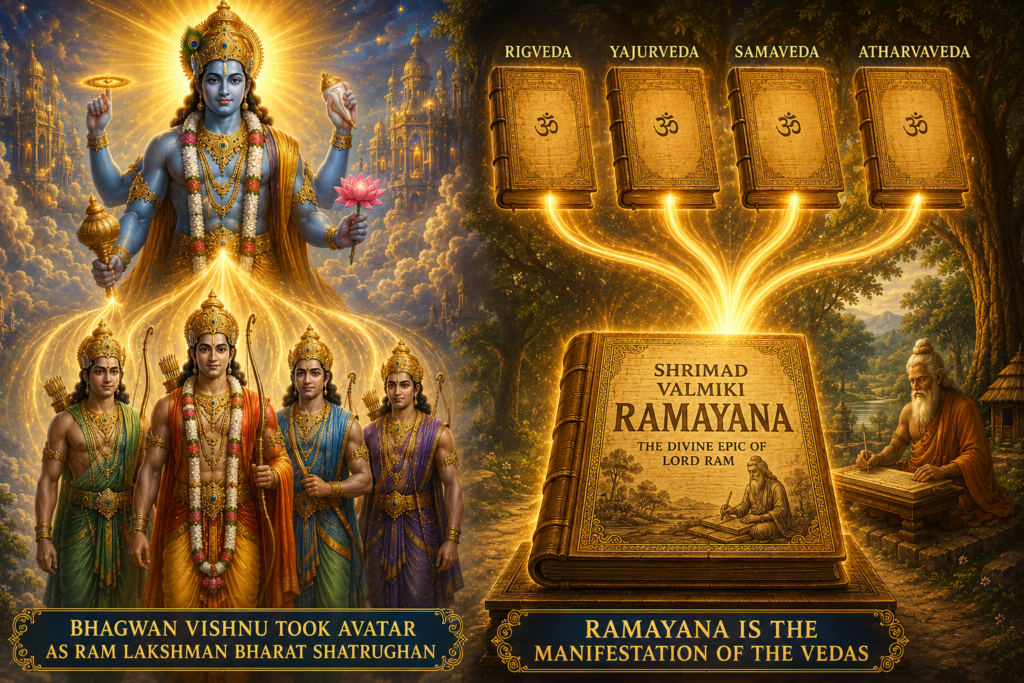
Bhagwan, though One, manifested on earth as Ram, Lakshman, Bharat, and Shatrughna and Four Vedas (Rigveda, Yajurveda, Samaveda, and Atharvaveda) manifested together as the Shrimad Valmiki Ramayana.
Maharshi Valmiki also alludes to this truth in the Balakanda:
Kritvatmanam Chaturvidham
Meaning: The One Supreme Being manifested Himself in four forms.
Traditional Acharyas explain that just as Bhagwan appeared in four divine forms, the four Vedas also came together through Maharshi Valmiki to manifest as a single sacred scripture—the Shrimad Valmiki Ramayana.
Sri Govindaraja Swami further explains that these four divine brothers are not merely historical personalities. They are the living embodiments of four supreme principles of Dharma, each representing a distinct path of righteous living. Understanding these four principles reveals yet another layer of the spiritual depth of the Ramayana.
Shri Ram, Lakshman, Bharat and Shatrughna: The Embodiments of the Four Supreme Dharmas
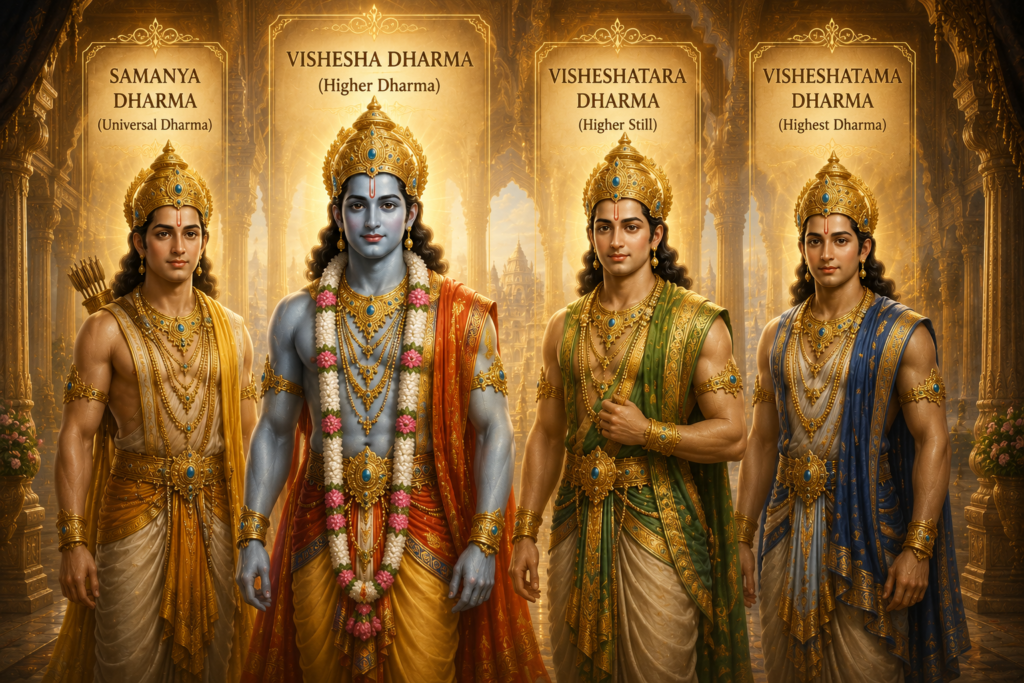
Sri Govindaraja Swami explains in his Ramayana Bhushana that Shri Ram, Shri Lakshman, Shri Bharat and Shri Shatrughna are the living embodiments of the four supreme forms of Dharma. Through their lives, they demonstrate the progressive path of righteous living.
Shri Ram – Samanya Dharma (Universal Dharma)
Shri Ram embodies Samanya Dharma, the universal principles that apply to every human being. Truthfulness, keeping one’s word, honouring one’s parents, protecting society and upholding righteousness are all reflected in His life. By willingly accepting fourteen years of exile to honour His father’s promise, Shri Ram established the highest standard of righteous conduct.
Shri Lakshman – Vishesha Dharma (Higher Dharma)
Shri Lakshman represents Vishesha Dharma. When faced with the choice between ordinary worldly duties and the personal service of Bhagwan Shri Ram, he chose complete devotion to the Lord. Throughout the fourteen years of exile, his life was dedicated entirely to serving Shri Ram and Mata Sita.
Shri Bharat – Visheshatara Dharma (Higher Still)
Shri Bharat embodies Visheshatara Dharma. Although his heart longed to remain with Shri Ram in Chitrakoot, he accepted the Lord’s command and returned to Ayodhya. Instead of ruling as king, he placed Shri Ram’s wooden sandals upon the throne and governed only as His humble representative. His life teaches that the will of Bhagwan is greater than one’s own wishes.
Shri Shatrughna – Visheshatama Dharma (The Highest Dharma)
Shri Shatrughna represents Visheshatama Dharma, the highest expression of selfless service. He sought neither power nor recognition and devoted his entire life to serving Shri Bharat. Sri Govindaraja Swami explains that serving a true devotee of Bhagwan is itself one of the highest forms of Dharma. Shri Shatrughna’s quiet and selfless life stands as the perfect example of this principle.
Conclusion
The principles discussed in this article reveal a dimension of the Shrimad Valmiki Ramayana that is unfamiliar to many readers. When Bhagwan Vishnu, descended as Shri Ram, the Vedas themselves manifested as the Ramayana.
Ramayana Grantha is embodying the twenty-four syllables of the Gayatri Mantra, this fact is also an amazing secret not known to most hindus.
Sri Govindaraja Swami’s exposition of the four supreme Dharmas embodied by the four brothers, further reveals the profound Vedic foundation of this sacred Itihasa.
When viewed together, these teachings transform our understanding of the Ramayana. It is not alone a sacred narrative of Bhagwan Shri Ram’s Avatar Leela; it is a scripture in which the wisdom of the Vedas, the spiritual significance of the Gayatri Mantra, and the eternal principles of Sanatan Dharma are woven together into a single divine composition.
For this reason, the Shrimad Valmiki Ramayana is revered in the Sanatan tradition as the manifestation of the Vedas themselves.